Viewing entries tagged
reverse osmosis

Unboxing Bluevua ROPOT Lite Countertop Reverse Osmosis System

1 Comment

Unboxing Bluevua ROPOT Lite Countertop Reverse Osmosis System

< Back To All Blogs

12/11/2022

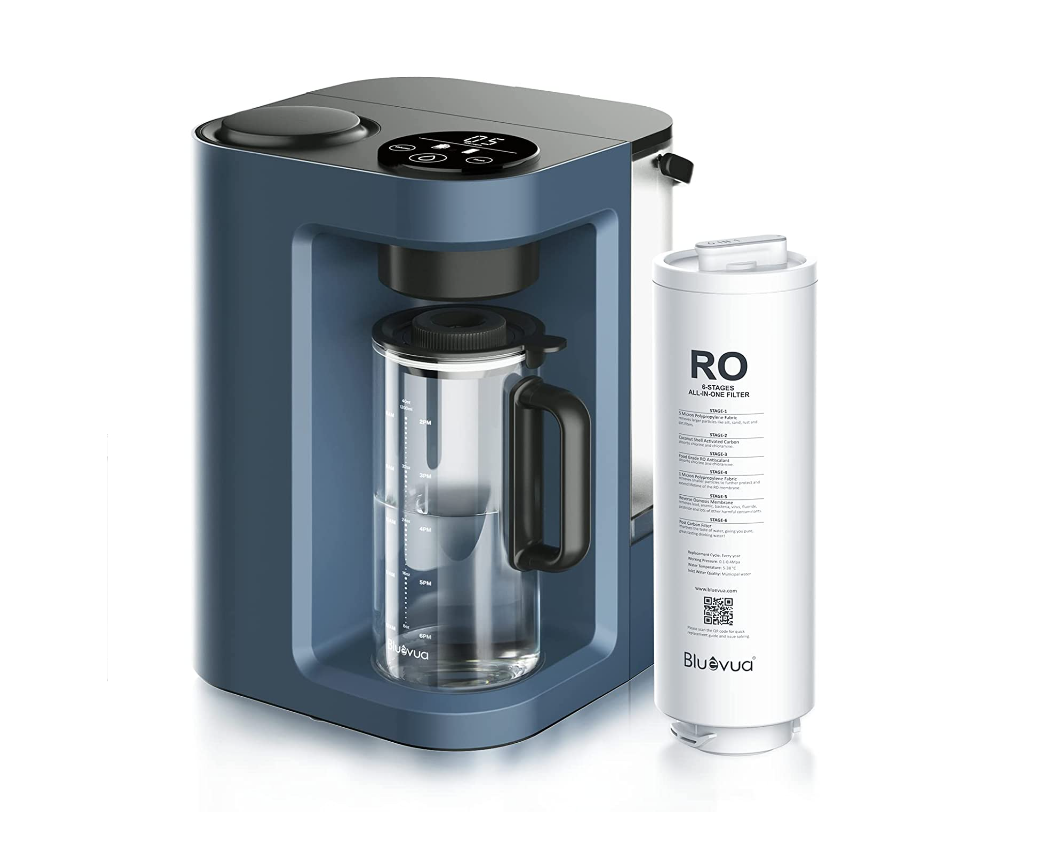
I bought this Bluevua's ROPOT Lite Countertop Reverse Osmosis (RO) System to be able to offer to our water customers a world class countertop RO system that produces excellent drinking water for years to come. We evaluate new systems, and if they pass our rigorous testing then we recommend them to our customers. This countertop RO system is perfect for people who want clean drinking water without having to do any special plumbing under their kitchen sink. It’s the perfect size and it looks nice on your counter. It will generate a lot of interest from your friends and family that see it, and you can take pride knowing you are helping the environment by not having to constantly buy bottled water.

I am absolutely thrilled to own Bluevua's ROPOT Lite Countertop Reverse Osmosis (RO) System.  This system is absolutely streamlined and elegantly designed. The dark blue color adds to the system’s elegance. It has curved, smoothed, and beveled edges which make it look like an expensive countertop RO system. System comes with a 1.2-liter borosilicate glass carafe and a glass infuser for making fruit infused water. Included are six different recipes for making fruit-infused water, and the system setup instructions are written well and easy to follow. This system is slightly smaller from Bluevua’s regular ROPOT system but is it still large enough to make enough RO water for an entire family of 2-3 people.  You simply plug it in, flush the six-stage single filter, and start making clean RO water for the entire family with no plumbing needed!

This countertop RO system has a single filter which has all six stages needed for producing high quality RO water.  The great thing about a single filter is that changing it is a breeze as opposed to the inconvenience of having to change six different filters on a tank RO system.  The first stage is 5-Micron Polypropylene Fabric to remove large particles like silt, sand, rust, and dirt.  The second stage is Coconut Shell Activated Carbon Filter to absorb chlorine and chloramine.  The third stage is a Food Grade RO Antiscalant to eliminate mineral scale to prevent the scaling and fouling of the RO filter membrane.  The fourth stage is a 1-Micron Polypropylene Fabric to remove smaller particles to further protect and extend the lifetime of the RO membrane.  The fifth stage is the Reverse Osmosis Membrane Filter to remove lead, arsenic, bacteria, virus, fluoride, pesticides, and 1000+ other harmful contaminants.  The sixth stage is a Post Carbon Filter to condition and further improve the taste of the water.

The ROPOT Lite RO system has a real-time filtered water quality indicator (e.g. real-time Total Dissolved Solids measurement).  There is a button on the LED interface to pick the volume of water to produce – 1.2L or 0.65L with a water volume indicator.  ROPOT Lite RO system has a filter life indicator, so you know when to change the ROPOT Lite water filter, and there is a manual flush button so you can flush the system when a new filter replacement is installed.

The first time you use the countertop system you need to clean the glass carafe and the water tank with hot water. To clean out the protective liquid in the four filters you need to fill the RO tank to the max level and run the water through the machine 4-6 times. After each time throw the water away in the carafe and repeat the process. During the first two rounds, the raw water in the tank will automatically be filled into the filters, therefore there may be no water coming out in this phase. For the first 3-5 rounds, it is normal that the pure RO water may turn black.

Using this countertop RO system will produce you drinking water with a Total Dissolved Solids (TDS) measurement between 5-15 parts per million (ppm) depending on your water source. This TDS level is the same as excellent quality drinking water you would pay for in the store that is created in a similar way through an industrial reverse osmosis process. Save your money, stop buying bottled water, and protect the environment by investing in the Bluevua ROPOT Lite Countertop Reverse Osmosis System.
 

1 Comment

Unboxing Bluevua RO100 ROPOT Countertop Reverse Osmosis System

1 Comment

Unboxing Bluevua RO100 ROPOT Countertop Reverse Osmosis System

< Back To All Blogs

3/6/2022

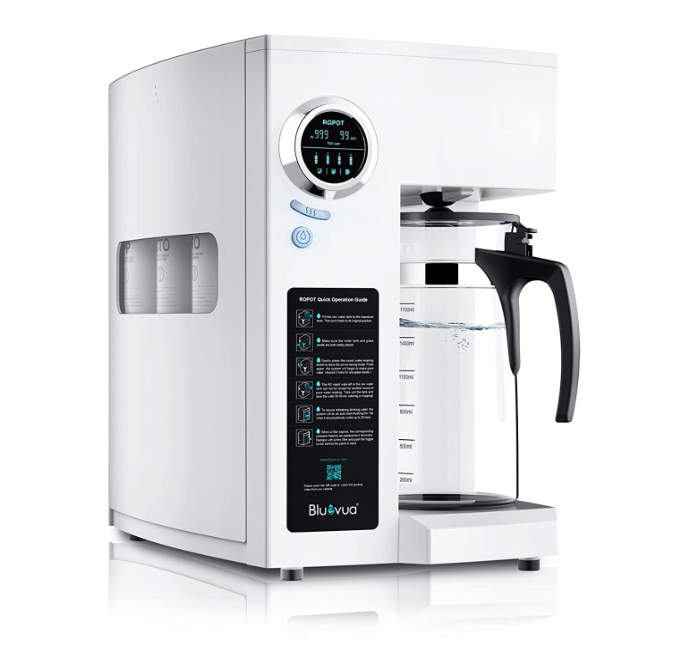
I bought this Bluevua RO100 ROPOT Countertop Reverse Osmosis System to be able to offer to our water customers a world class RO system that produces excellent drinking water for years to come. We evaluate new systems, and if they pass our rigorous testing then we recommend them to our customers. This countertop RO system is perfect for people who want clean drinking water without having to do any special plumbing under their kitchen sink. It’s the perfect size and it looks nice on your counter. It will generate a lot of interest from your friends and family that see it, and you can take pride knowing you are helping the environment by not having to constantly buy bottled water.

Let’s first talk about the filters that come with this system.  The Polypropylene Sediment Filter (PP) removes dirt, corrosion, sediment, red worms, sand, and other physical particles, and it must be replaced yearly. The Coconut Carbon Block Filter (CTO) removes all the additional chlorine and organic matters from the water without releasing carbon ashes, and it must be replaced yearly. The Reverse Osmosis Membrane Filter (RO) removes bacterial, virus, antibiotics and other harmful substances, heavy metals and pesticide residues from water, and it must be replaced every two years. The Post Carbon Filter (PCF) improves the taste of the water and has to be replaced yearly. The quality of these filters is world-class, and replacement filters are budget friendly.  When replacing the filters you pull the filter toward you from the bottom, twist, and then replace it with a new one (8 seconds to replace each filter).

The countertop RO system has three volume settings that let you know when a 1/2 liter, 1 liter, or 1.5 liters of clean reverse osmosis water has been produced. You simply fill RO tank with tap water and then push the round water-making button on the front of the machine, and it will begin the process of producing reverse osmosis water.

The first time you use the countertop system you need to clean the glass carafe and the water tank with hot water. To clean out the protective liquid in the four filters you need to fill the RO tank to the max level and run the water through the machine 4-6 times. After each time throw the water away in the carafe and repeat the process. During the first two rounds, the raw water in the tank will automatically be filled into the filters, therefore there may be no water coming out in this phase. For the first 3-5 rounds, it is normal that the pure RO water may turn black due to activated carbon particles.

Using this countertop RO system will produce you drinking water with a Total Dissolved Solids (TDS) measurement between 15-30 parts per million (ppm) depending on your water source. This TDS level is the same as excellent quality drinking water you would pay for in the store that is created in a similar way through an industrial reverse osmosis process. Using this countertop RO system, I know my health is being protected when I can validate the performance myself with a basic TDS meter.


1 Comment

How do tank reverse osmosis systems work with the John Ellis Water Machine?

Comment

How do tank reverse osmosis systems work with the John Ellis Water Machine?

< Back To All Blogs

1/30/2022

I bought this Bluevua Six Stage Reverse Osmosis System (100 GPD at 0.26L/Min Flow) to keep a constant flow of reverse osmosis (RO) re-mineralized water flowing into my John Ellis Living Water Machine (LWM-5) Distiller.  This RO system does NOT have an auto shut off valve like other tankless reverse osmosis systems.  The two hour auto shut off valve is inconvenient on other tankless RO systems because you have to turn it back on every two hours to keep a constant flow of water running into the John Ellis Living Water Machine. You can’t beat the price point for this RO system when you consider filtration performance for contaminant removal, mineral removal and a constant flow rate for the John Ellis Machine.  When the reverse osmosis water storage tank is full, it also puts a good flow rate through my Kangen K8 Water Ionizer as well.

The filters used on the Bluevua Six Stage RO System are a reverse osmosis membrane filter, coconut carbon block filter, granular activated carbon filter, polypropylene sediment filter, and a mineral ball filter for remineralization.  Most of the filters on this unit need to be replaced between 6 months - 2 years.  You will get a lot of use out of this system for years to come you can simply contact us directly to get more filters.

The Bluevua Reverse Osmosis System comes packaged very well. The instructions are very easy to understand, and system installation is a breeze.  No parts were missing, and I was surprised how sturdy and well-built this RO system is.  The metal frame all the filters are attached to is heavy and well-constructed.  I was able to get the system setup in under 30 minutes, and 10 of those 30 minutes were spent reading through the instructions. This system comes with a one-year warranty, and it will last you for many years to come.

For our current water ionizer offering, see AlkaViva Vesta H2 Water Ionizer.


Comment

How much molecular hydrogen can the Kangen SD501 Platinum produce off reverse osmosis water with remineralization?

Comment

How much molecular hydrogen can the Kangen SD501 Platinum produce off reverse osmosis water with remineralization?

< Back To All Blogs

12/13/2021

I have been experimenting with different ways of running reverse osmosis (RO) water that has a calcium sulfite remineralization filter on the RO water line out of the tankless Nobana Reverse Osmosis System into a Kangen SD501 Platinum Water Machine. The goal at the end of the day to understand what minerals are necessary for effective electrolysis, and how to get the most molecular hydrogen possible out of a water ionizer. Some questions to ask when experimenting are the following:

  1. Do you know what is in your city water? Do you need all the minerals in the tap water for effective electrolysis. Do you know how to remove unnecessary minerals from your tap water? Is there anything toxic in your city water? Do you know what minerals are corrosive and what minerals aren’t?

  2. If you remove any of tap water minerals, will you affect the ability to produce molecular hydrogen and alkalinity as the water ionizer was intended?

  3. Do you have to re-mineralize reverse osmosis water in order to produce high levels of molecular hydrogen? If you don’t re-mineralize RO water does that affect potential hydrogen (pH) levels? If yes, is the water still safe to consume?

  4. Can you get more molecular hydrogen by running the machine slower or faster? How do you measure for molecular hydrogen.

It is a fact that all home water ionizers need minerals in order to run effectively. A lot of people with water ionizers do not know what minerals are important for effective electrolysis or ways to produce more molecular hydrogen than a water ionizer was originally intended. You can only figure this out if you have a home set up that allows you to experiment with different ways of producing very high-quality clean water with different flow rates and filters that give enough contact time to the water to actually remove 99.99% of particulates. Then you also need very accurate meters down to at least two decimal points to measure each stage of the water production process as your tweak for experimentation and new ideas.

Here is a video below of me experimenting with different ways to bottle molecular hydrogen, and also testing what the new molecular hydrogen levels in the Kangen water are since installing my calcium sulfate remineralization filter on the RO water line coming off my tankless RO system. Enjoy and more videos to come soon!

Comment